

Informativni videozapisi
U Greenport Allianceu trenutno razvijamo seriju od 10 videozapisa u kojima istražujemo kako pomorski sektor može ubrzati prijelaz prema održivijoj pomorskoj budućnosti.
U seriji će stručnjaci iz industrije, pomorski profesionalci i partneri podijeliti uvide u operativne prakse, promjene ponašanja u pomorskim operacijama, održivo donošenje odluka u lukama te osposobljavanje za sadašnju, kao i za sljedeću generaciju pomorskih profesionalaca.
The human factor matters: quantifying its impact on tugboat fuel consumption
Olivier Schalm, Joris Lemmens, Luca De Wilde
Antwerp Maritime Academy, Belgium
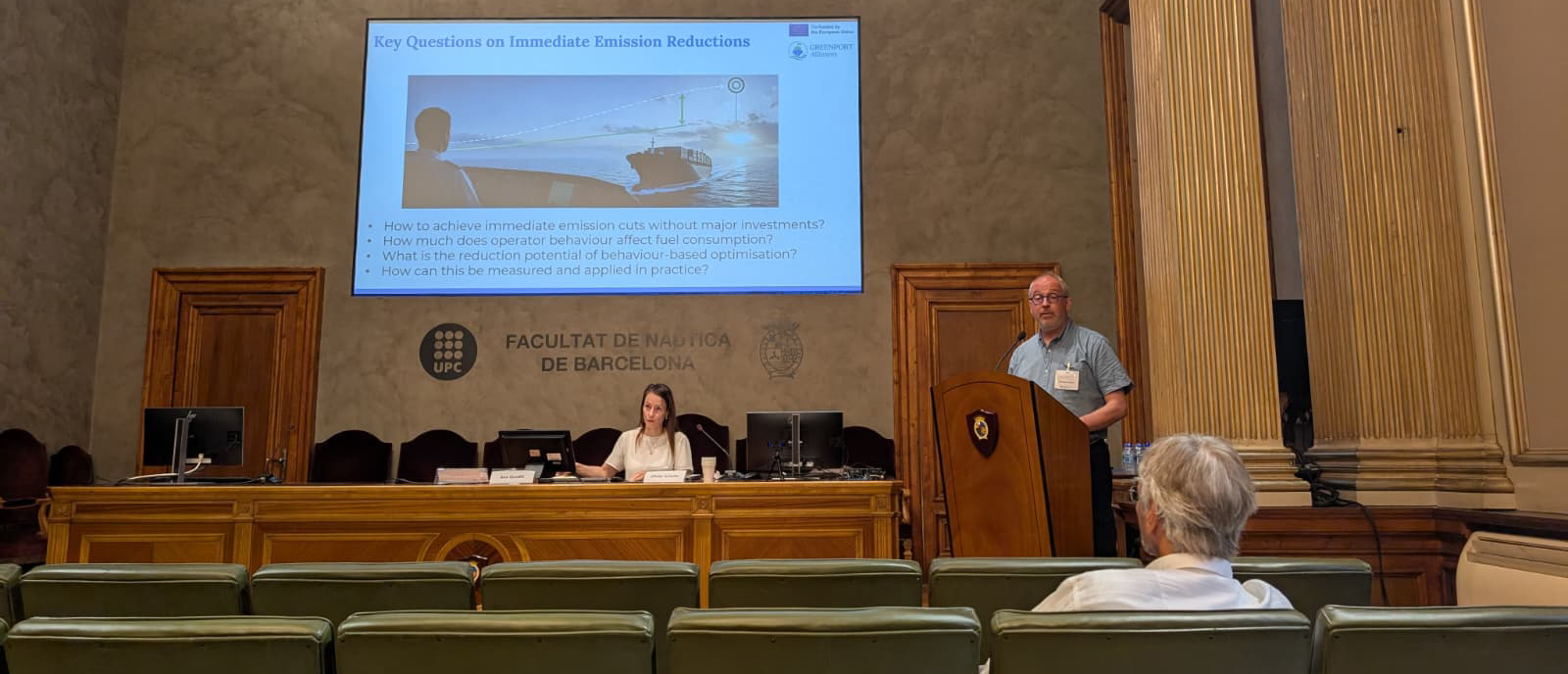
At the 11th International Conference on Maritime Transport (MT’26) in Barcelona, Olivier Schalm from Antwerp Maritime Academy presented research showing that operator behaviour can cause substantial differences in tugboat fuel consumption, even when the vessel, task and operating conditions remain identical. The study also proposed a three-level assessment method that converts simulator data into practical feedback on overall performance, high-consumption operating patterns and inefficient command sequences. The findings demonstrate that behavioural optimisation can provide an immediate route towards lower fuel use, operating costs and emissions while the maritime sector continues its transition towards new fuels and propulsion technologies.
The maritime energy transition is often approached primarily as a technological challenge involving alternative fuels, new propulsion systems and vessel retrofits. These developments are essential, but their large-scale implementation requires considerable time and investment. The sector cannot wait until every vessel has been replaced or retrofitted before taking action, especially as the 2050 targets are rapidly approaching. Improving the interaction between operators and the vessels already in service therefore offers an additional and immediately available pathway towards lower fuel consumption.
The central message of the presentation was that maritime decarbonisation depends not only on the development of new technologies, but also on how people operate the technologies that are already available. Behavioural optimisation cannot replace technological innovation, but it can complement it by reducing avoidable energy use in the short term. Better timing, smoother commands and greater anticipation can improve the interaction between the operator and the vessel without requiring major modifications to the ship.
Isolating the human factor
To investigate the influence of operator behaviour on fuel consumption, a controlled experiment was organised using the Antwerp Maritime Academy’s Kongsberg K-Sim simulator. Participants completed the same sailing and port-side mooring assignment with the same tugboat model and under identical weather, traffic and operational conditions. Because the vessel, environment and assignment remained constant, the human participant was the principal variable between the simulator runs. This controlled setup made it possible to compare different operational styles and to relate differences in fuel use mainly to the way the tugboat was operated.
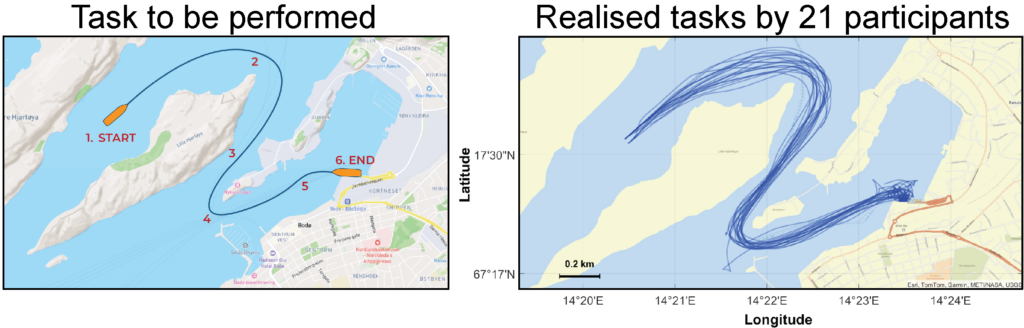
The results revealed substantial variation in the total fuel consumption required to complete the same assignment. Although every participant worked with the same vessel and pursued the same operational objective, they used different combinations of engine, rudder and thruster commands. These differences affected the timing, intensity and smoothness of the manoeuvre and ultimately resulted in different levels of fuel consumption. The experiment confirmed that fuel use is not only a technical property of the vessel. It is also the final outcome of a human–machine process in which operational decisions are translated into engine response, vessel motion and energy consumption.
From simulator data to participant assessment
The presentation proposed a structured method for converting the time series of ship parameters generated by the simulator into an assessment of each participant. The method was designed to answer three related questions: who operated the vessel efficiently and by how much, where excessive fuel consumption occurred, and why these inefficient moments arose. The assessment consists of three complementary levels, progressing from the overall performance of the voyage to broader operational patterns and, finally, to specific events within the time series.
At the first level, overall performance is assessed using aggregated indicators such as total fuel consumption, voyage duration, distance travelled and power use. This is a relative assessment, in which all participants are compared with the best-performing participant in the group under the same experimental conditions. The difference between each participant and this best observed performance provides an estimate of the potential reduction in fuel consumption, operating costs and emissions. The best participant is not assumed to have performed a theoretically optimal manoeuvre, but serves as a realistic and attainable benchmark because that level of performance was achieved during the experiment.
At the second level, operational patterns are assessed individually using frequency distributions of variables such as fuel rate, speed and acceleration. Unlike the first method, this assessment does not primarily compare participants with one another. Instead, a personalised threshold is defined for each participant based on their own frequency distribution. The upper tail of the distribution represents unusually high or potentially avoidable fuel-consumption events and should therefore be minimised. By identifying and mapping the measurements that exceed this individual threshold onto the vessel’s trajectory, the method shows where each participant experienced excessive fuel use during the approach or mooring manoeuvre. This creates a participant-specific assessment that remains useful even when no comparison group is available.
At the third level, individual time-series events are analysed by comparing operator commands with the corresponding response of the propulsion system. For example, the ordered engine RPM can be compared with the actual RPM reached by the engine. When a new command is issued before the engine has had sufficient time to respond to the previous one, the earlier command cannot be fully executed and may have little or no effect on the vessel’s motion. A succession of rapidly changing orders can result in ineffective control actions, because the engine is continually responding to commands that are replaced before the requested RPM is reached. This analysis identifies command patterns that do not translate into an effective propulsion response and shows where better timing and greater anticipation could improve the interaction between the operator and the engine.
From measurement to training
To assess the effect of awareness training on the relationship between human behaviour and fuel consumption, maritime professionals perform the same simulator task before and after completing the course. Because the simulator provides controlled and repeatable conditions, both runs can be compared directly. The results show a general trend towards lower fuel consumption after the training for most participants. Although the degree of improvement varies between individuals, the overall reduction demonstrates that greater awareness and targeted feedback can influence operational behaviour and support more energy-efficient tugboat manoeuvres.
This research was conducted within the GREENPORT Alliances project, with support from the European Commission.
Greenport’s study titled “A COM-B Perspective on Integrating Sustainability into Maritime Education” accepted for publication
A new study titled “A COM-B Perspective on Integrating Sustainability into Maritime Education”, developed collaboratively by Piri Reis University (PRU), Constanta Maritime University (CMU), and the University of Rijeka (UNIRI), has been accepted for publication in the Scientific Journal of Maritime Research (POMORSTVO) and will appear in its June 2026 issue.
Addressing the urgent need for decarbonisation in an industry responsible for over 80% of global transport and approximately 3% of global greenhouse gas emissions, the article explores how sustainability can be more effectively embedded into Maritime Education and Training (MET). The study reveals that while educators demonstrate strong motivation to incorporate sustainability and behavioural change approaches into their teaching, they face limitations in capability—particularly in terms of training and resources—and opportunity, such as access to real-life case studies and interactive learning environments. The findings highlight the critical role of educators in shaping sustainable mindsets and practices among future maritime professionals, offering actionable insights to support the transition towards greener and more resilient port and shipping operations.
Artificial Intelligence in Practice:
Lessons from Dr. Arthur Kordon for the GREENPORT Alliance
On the 1st of October, Nikola Vaptsarov Naval Academy hosted a lecture event by Prof. Dr. Arthur Kordon, a Bulgarian-born expert internationally recognised for his contributions to Applied Artificial Intelligence (AI).
As the GREENPORT Alliance prepares to launch the piloting phase of its three educational streams , the project enters a decisive moment in translating European policy priorities into practice. The project’s mission is to enable a sustainable transition of the port sector through innovation, digitalisation, and behavioural change. Within this context, a meeting has been held with Prof. Dr. Arthur Kordon. His works provide a model of how advanced technologies can deliver measurable impact when aligned with clear business and sustainability objectives.
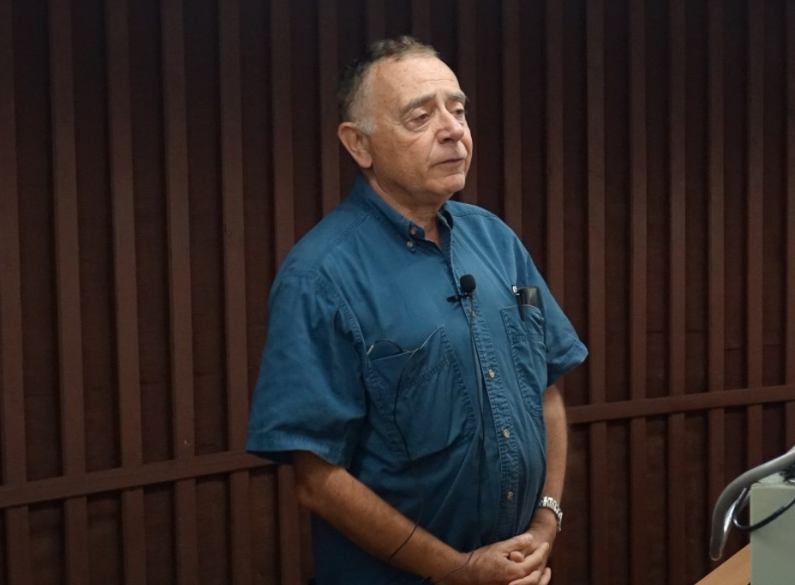
Dr. Kordon stands out among the pioneers who transformed artificial intelligence from an academic curiosity into a practical management instrument. His long career in industrial innovation demonstrates that AI is most effective when it becomes an enabler of operational intelligence — helping organisations make informed, data-driven decisions in real time. His methodology integrates scientific rigour with business logic, offering a roadmap for companies seeking to create value through intelligent systems.
In works such as Applying Computational Intelligence: How to Create Value (Springer, 2009) and Applying Data Science: How to Create Value with Artificial Intelligence (Springer Nature, 2020), Kordon presents a holistic approach that resonates deeply with the GREENPORT vision: using data, digital tools, and adaptive learning to improve performance while advancing sustainability. His philosophy could be summarised as “intelligence applied to real problems” — a core principle that underpins GREENPORT’s educational model.
A central element in Dr. Kordon’s applied work is the concept of Digital Twins — dynamic digital representations of physical assets, systems, or processes. By combining data from sensors, historical records, and predictive algorithms, digital twins allow continuous monitoring, forecasting, and optimisation.
Within the port ecosystem, this translates directly into the ability to:
- anticipate equipment failures through predictive maintenance;
- optimise tugboat or terminal energy use through intelligent energy analytics;
- simulate logistics operations for emission reduction and throughput efficiency;
- and evaluate cost-saving and decarbonisation scenarios without interrupting real operations.
The GREENPORT strategy strongly embraces this vision. Under Work Package 4, the HEI, VET, and TTT curricula integrate simulation-based learning, data-driven case studies, and digital twin modelling as educational tools. Dr. Kordon’s principles provide the theoretical and methodological foundation to frame these learning experiences in a way that connects directly to the operational realities of port services.
Another essential aspect of Kordon’s philosophy is his understanding that technology alone cannot drive transformation — people do. His books and lectures consistently emphasise the role of human interpretation, trust, and accountability in AI-based systems. For GREENPORT, this notion of human-centred digitalisation is pivotal. The three educational streams are not only meant to teach new tools but to reshape professional behaviour and mindset. Whether it is a university student analysing emissions through a data-science module, a tug master using predictive dashboards to plan manoeuvres, or a trainer facilitating change in port organisations, the project promotes an AI-literate workforce that combines digital competence with ethical responsibility.
The European Green Deal and the Digital Europe Programme both call for synergies between sustainability and digitalisation. The GREENPORT project responds directly to this call by linking decarbonisation, digital transformation, and workforce upskilling. Dr. Kordon’s interdisciplinary framework exemplifies this balance. His experience shows that successful AI deployment requires a clear understanding of the system’s energy and resource dynamics — precisely the challenge the maritime and port sectors face today. Through AI-enabled insights, ports can reduce emissions, optimise vessel movements, forecast demand, and manage assets in line with the EU ETS and FuelEU Maritime frameworks. Integrating such expertise into GREENPORT’s curricula ensures that learners grasp not only how AI works but why it matters for climate action, circular economy, and competitive advantage.
The forthcoming piloting of the GREENPORT educational modules represents more than a testing phase — it is the first real step toward building a European network of intelligent and sustainable ports. By embedding Kordon-inspired AI principles into the training ecosystem, the project will demonstrate how learning can accelerate decarbonisation and digital readiness simultaneously. The synergy between human expertise, technological intelligence, and environmental responsibility forms the backbone of the GREENPORT strategy. As Dr. Kordon himself argues, “AI creates value only when intelligence meets purpose.” The same applies to GREENPORT: each educational activity, simulation, or module is designed not for technology’s sake, but for the purpose of achieving measurable impact — lower emissions, greater efficiency, and empowered people.
By linking the legacy of Dr. Arthur Kordon’s applied AI methodologies to the mission of GREENPORT, the project demonstrates that Europe’s green and digital transitions are not separate agendas but two facets of the same transformation. The upcoming piloting phase will provide an opportunity to validate this approach across education levels and national contexts, ensuring that future port professionals — from students to trainers — can operate confidently in a data-driven, low-carbon economy.
Through its multidisciplinary design, the GREENPORT project proves that when intelligence meets purpose, sustainability becomes not only a policy goal but a practical, teachable, and achievable reality.
The time has come for the GREENPORT project to translate its research into real-world change!
Based on these recommendations, three tailored learning streams are being launched:
Higher Education (HE) – A 4-ECTS academic course for maritime students, combining theory, simulator tasks, and digital tools to build skills in eco-navigation, fuel efficiency, and emissions tracking.
Vocational Education & Training (VET) – A practical 12-hour course for tug, pilot boat, and port service personnel, focused on energy-saving operations, emissions monitoring, and digital coordination.
Train-the-Trainer (TTT) – A 20-hour professional development program for maritime educators, equipping them to deliver sustainability-focused instruction using simulators, behavior modeling, and case-based teaching.
The Methodology Report will emphasize learning-by-doing, stakeholder engagement, and knowledge transfer through real port case studies. The use of simulators and performance feedback tools is central to fostering behavioral change—empowering participants to implement emission-reducing actions in their daily work.
Together, we are preparing the next generation of maritime professionals to operate more cleanly, efficiently, and collaboratively in the evolving green port ecosystem.
#GREENPORT #MaritimeEducation #Sustainability #GreenPorts #IMO #Decarbonisation #FitFor55 #MaritimeInnovation #SimulatorTraining #PortOperations
Početak projekta i konferencija dionika
Kao koordinator za projekt GREENPORT Alliances, Sveučilište Piri Reis ugostilo je devet projektnih partnera iz sedam zemalja 28. i 29. veljače 2024 Početni sastanak koji je održan prvog dana, obuhvatio je sastanak cjelokupnog konzorcija te se raspravljalo o planu rada i daljnjim koracima za trajanja projekta.
Konferencija dionika označila je prvu prekretnicu projekta i svjedočila angažmanu ključnih dionika iz pomorske industrije i obrazovnih institucija. Tijekom konferencije svaki projektni partner predstavio je svoje uloge i odgovornosti unutar projekta, te obveze koje će preuzeti tijekom 36 mjeseci projekta. Predstavnici turskog pomorskog sektora kao što su Sanmar Shipyards, Tursko udruženje brodograditelja (GISBIR), Yanmar Holding, Sakura Marine, Na konferenciji su aktivno sudjelovali Kilyos Shipping, Kamer Marine, GDS Engineering, CSS Turkey, NAVTEK, Gübretaş Port, GISAŞ Port i Tursko udruženje pilota. Uvid u inovativne strategije za smanjenje emisija ugljika unutar sektora podijeljen je kroz prezentacije koje su održali predstavnici Turkon Linea i GISAŞ
Project Update: Diving Deeper into Sustainable Shipping
Activities outlined in “Task 3.2 – Scientific Analysis” commenced in November 2024 (M10). These activities will span a total period of six months, concluding in April 2025. This task plays a pivotal role within the project as it focuses on developing alternative analyses and identifying case studies to demonstrate how the application of different operational methodologies can significantly impact harmful gas emissions. The planned activities are divided into three main phases, each characterized by specific objectives and a targeted operational approach.
The first phase, referred to as desk analysis, will take place between November 2024 and January 2025. This phase will involve the preliminary collection of relevant data and the structuring of case studies. Based on the review of available documents and sources, it represents the starting point for developing alternative operational scenarios. Subsequently, during the second phase, from February to mid-March 2025, the development of case studies will proceed. This activity will incorporate innovative analytical approaches, including targeted interviews with industry experts, to delve deeper into the identified methodologies. Finally, the third phase, from mid-March to April 2025,
will focus on integrating lessons learned. The goal will be to translate the outcomes from the previous phases into practical and concrete recommendations for designing specific training curricula.
The activities of Task 3.2 build upon the results of “Task 3.1 Cross-sectoral identification of best practices”, which identified 13 practices classified into three main clusters. Cluster 1, focused on emission reduction, addresses strategic aspects related to environmental sustainability. Cluster 2 emphasizes operational efficiency improvements, prioritizing technical and managerial aspects. Cluster 3 centers on engagement and professional development, highlighting educational and training dimensions.
These practices were selected through an in-depth analysis of scientific articles, institutional documents, and questionnaires, involving partners and industry operators such as pilots and tugboats. Specifically, the questionnaire survey generated 35 useful responses, which led to the addition of 4 new practices to the initial list, while retaining the original cluster classification.
An additional phase of work resulted in the ranking of 12 Best Practices, evaluated using 10 distinct parameters divided across five perspectives: environmental, economic, social, technical, and institutional. This multidimensional evaluation provided a solid foundation for designing training curricula, which will be further enriched by the outcomes of Task 3.2.
Task 3.2 represents a crucial milestone in the overall project trajectory, as it lays the groundwork for the subsequent Task 3.3, which will culminate in the preparation of an internal document containing targeted recommendations for training development. The integrated approach adopted in Work Package 3 stands out for its ability to ensure a systemic and multidimensional vision, actively involving experts and stakeholders. This method optimizes project outcomes and promotes an operational model oriented toward the sustainability of port operations.


 Croatian
  English
  Turkish
  Romanian
  Bulgarian
  Dutch
Dutch  Italian
  Portuguese